How Pitwall reads a lap
A debrief is only worth trusting if you can see how it was made. This page is the method, in plain words: what the file has to contain, how laps and corners are cut, how the theoretical best is built, what each coaching call is triggered by, and where the data runs out.
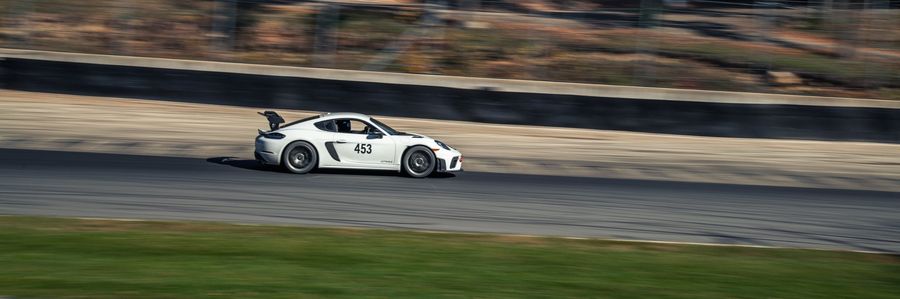 Road America, October 2026.
What it needs from your file
Time and GPS position are the minimum. Everything else is used when it is there: speed, throttle, brake pressure or a brake switch, longitudinal and lateral g, steering angle, yaw rate, the stability-control flag, RPM and gear.
- Formats. CSV and TXT exports with one column per channel (Porsche Track Precision, RaceChrono, AiM Race Studio), VBOX .vbo files, and raw AiM .xrk and .xrz logs. AiM logs are converted on your own device with AiM's library before anything is analyzed.
- Rate. Channels are resampled to one uniform rate per file. A phone logs GPS about once a second; a dedicated logger ten to twenty-five times a second. Both work, but see the limits below: a 1 Hz file places corners and crossings less precisely.
- Missing pedals. When a file has no throttle or brake channel, both are estimated from how the car was accelerating. Estimated channels are drawn with a hollow dot and labelled "est", and no coaching call that depends on where a pedal was is ever made from an estimate.
- Several files. Up to six files from the same car and track can be analyzed together. A file that is a byte-for-byte copy of another is counted once.
Finding and lining up laps
Start/finish
If the logger wrote a lap number or a lap timer that resets, that is where the line is. Otherwise, for a track in the library, the saved start/finish line is used. For an unknown circuit the line is placed on the straight leading into the first corner.
Which laps count
A lap is timed when it was recorded end to end with no logging gap, its time is within 75% of the session's median, its length is within 10% of the median lap length, and it is within 10% of the fastest lap in the set. Out laps, in laps and cool-down laps fall out of that filter and are shown with the reason. If nothing passes, every lap with a recorded start and finish is kept rather than guessing.
Lining them up
Every lap is projected onto the path of the fastest lap and resampled every 2 m along it. From then on laps are compared by position, not by time, so "at the apex of T9" means the same spot on every lap even when the laps were driven at different speeds. The GPS path is smoothed adaptively: heavily on straights, lightly through corners so apexes stay sharp.
Corners and their phases
Bends are found from the turn rate of the smoothed driven line, kinks included, with their direction, how much heading they change and whether they were taken flat.
For a track in the library, the circuit's official turn list is matched to those bends by order, direction and size, or placed from positions other drivers have saved on that circuit. A bend that could not be matched to an official number is flagged as estimated. For a circuit without published numbering, corners are numbered in the order they appear.
A corner's segment runs from the end of the straight before it to the end of the straight after it, so its time includes the braking zone and the full exit. Inside the segment four phases are cut at the reference lap's own markers:
Approach runs to the brake point, braking to turn-in, turn-in to the apex, and exit from the apex to the end of the segment. Each phase's time is compared with the same phase on the reference lap.
The theoretical best
For every corner segment, Pitwall takes your quickest clean time through it from any complete lap in the set, then stitches those segments into one lap. That is the theoretical best. The gap on the summary is your best real lap minus that figure.
Why "theoretical". Stitching assumes you could carry each segment's best entry speed into the next, and a real lap can't always do that. Treat it as the target the data says is in the car and the driver already, not a promise of a lap time.
Traffic and bad segments
A segment where a lap was more than 6% plus a quarter of a second slower than that lap's own baseline, while cruising at part throttle, is marked held up, which is what waiting for a point-by looks like in data. A segment more than 12% plus 0.3 s slower is marked off pace. A segment next to a held-up one that is also slow and cruising is treated the same way. Marked segments are left out of the theoretical best, the coaching and the consistency figure, and a lap with any of them is not counted as clean.
Where the time goes
Each corner's loss is your best lap's time through its segment minus the theoretical best's time through the same segment. Those losses are ranked, and the three largest become the focus of the debrief. Inside each one the loss is split across the four phases, which is what decides whether the call is about braking, the apex or the exit.
The per-corner losses add up to the gap on the summary by construction, so you can always trace the headline number back to specific places on the track.
The coaching calls
Pitwall's coaching is not a machine-learning model and nothing about your file is sent to one. Every call is a written rule with a stated threshold, listed here, so the same file always gives the same debrief and every finding can be checked against the trace it came from. Every rule names the channels it needs. If a file doesn't have a measured version of those channels, the call is not made, and the corner says which channel is missing instead. "Reference" below means the lap you are being compared with, usually the theoretical best.
Brake laterYou started braking at least 20 ft earlier than the reference did.needs brake timing (pressure or a brake switch)
Brake harder at the top of the zoneYour peak deceleration was at least 0.08 g below the reference's in this corner.needs brake timing, longitudinal g
Get to full brake pressure soonerIt took more than half a second to reach peak pressure, and at least 0.15 s longer than the reference.needs brake pressure
A lift (or a brush of the brake) is enoughYou braked where the reference didn't brake at all.needs brake timing, throttle
This one can be flatYou lifted where the reference stayed at full throttle.needs throttle
Carry more speed to the apexYour minimum speed was about 1 mph or more below the reference's.needs speed
Trail the brake into the turnYou released the brake before turning in, with less than 25 ft of overlap and a release quicker than 0.45 s.needs brake pressure, lateral g
Blend braking into corneringTotal grip (braking and cornering combined) sagged below 62% of what the car was using on either side of turn-in: for a moment it was doing neither.needs brake pressure, lateral g
Stop coastingYou were off both pedals for 50 ft or more between brake and throttle, and for longer than the reference.needs throttle, brake timing
The front is sliding mid-cornerYou were holding noticeably more steering than the car's actual turn rate called for, with the steering-to-yaw relationship calibrated on this car's own data first.needs steering angle, yaw rate, lateral g
The rear is stepping out on exitThe car rotated faster than the steering asked for while you were back on the power.needs steering angle, yaw rate, lateral g
Stability control is cutting in on exitThe car's own stability-control flag was active on the exit of this corner.needs the stability-control channel
Back to throttle soonerYou picked up the throttle at least 33 ft later than the reference.needs throttle
Commit to the throttle onceYou picked up the throttle, came off it again, then went back on during the exit.needs throttle
Better exit speedYour speed at the end of the segment was about 1.5 mph or more below the reference's.needs speed
There is more grip here than you have usedAcross all your laps, the most combined grip you used in this corner was under 86% of the most you used anywhere else on the lap. Not shown for kinks.needs lateral g
Most of the time goes in…When no specific rule fires but one phase still holds at least a tenth, the debrief names that phase and the exact stretch where the loss is steepest, so you still know where to look.needs speed
Calls are weighted by how much time they explain, and the corner's headline is the strongest one. The rest are listed under "more detail", each with the evidence it was built from.
Consistency and the technique scorecard
Consistency is the standard deviation of your clean laps, with the spread from fastest to slowest shown next to it. Under half a second is called tight, under a second okay, above that loose. It is there so you can tell a real change in technique from lap-to-lap noise: a change smaller than your spread hasn't shown up yet.
The technique scorecard grades six habits (using the grip, consistency, trail braking, braking, throttle, car balance) as strong, solid or needs work. Each grade is a count of how often the related calls fired across every corner on the lap, not a comparison with other drivers. "Needs work" on car balance means the balance calls fired in several corners, which is why the "one thing to work on" usually points at a habit rather than a single turn.
What it can't tell you
- Conditions. The data has no tire temperatures, no track temperature, no flags and no idea what traffic you could see. A theoretical best built from a session where the track changed can be optimistic.
- 1 Hz GPS. With one position a second, a car at 100 mph moves nearly 150 ft between samples. Corner markers and the start/finish crossing are interpolated, which is fine for ranking corners and shaky for hundredths. Expect tenths from a phone, hundredths from a dedicated logger.
- No pedal channels, no pedal calls. Estimated throttle and brake drive the pictures, not the verdicts. Balance calls need a steering channel and enough corners to calibrate against; without them they do not appear.
- Turn numbers. Official numbering comes from the circuit's own map. When your line doesn't match it cleanly, the corner is marked estimated and you should check it against your own knowledge of the track.
- Interpretation. A call says what the data shows and what to try. It does not know why you did it. A late throttle pickup can be the right call behind a slower car, and you were there.
The in-car timer
The lap timer at pitwallcoach.com/record uses the phone's own GPS, about once a second, and its motion sensors at about ten times a second. The start/finish line comes from the track library, a line you mark yourself, or the point where your lap closes on itself. Crossing times are interpolated between fixes. The live delta is measured by position along your best lap's path, not by elapsed distance, because GPS distance at 1 Hz varies by a few percent from lap to lap. The phone's accelerometer and gyroscope are calibrated against GPS so lateral and longitudinal g come out in the car's frame whichever way the phone is mounted.
Its recordings drop straight into a debrief, with the limits above: tenths, not hundredths, and no pedal calls unless a logger supplies them.
Where it runs, and who built it
Files are analyzed on Pitwall's server and are not kept unless you save the session to your garage. AiM logs are decoded on your own device first. Analytics only run if you accept them. The details are on the privacy page.
Pitwall is built by Evan, a certified HPDE instructor, from his own sessions and the questions students ask in the right seat. If a call looks wrong on your data, the feedback button on any debrief sends the file to him with your note. That is how the rules above get corrected.